
I haven’t run many races recently, which has emphasized the unique ways this happens for me here in India.
I am sure all runners have their little rituals, their way of preparing their mind and body, their way of approaching race day. So, maybe you can identify with me in some ways, or think I am crazy in other things. I invite you to walk with me through race day.
Three days before the 10k race:
I have my last relaxing run before the race. I try not to worry about speed, but I also make some decisions about the time I would be aiming for. I ask myself how my preparation went and accordingly decide what pace I should be aiming for.
My preparation did not go well at all since I just started scaling up my weekly distance after a prolonged injury. I was only able to manage as little as 20k per week for any weeks, even months. I did, however, have a promising speed session on Tuesday. For the first time in a while, I feel I can run as fast as I can endure without hurting my feet any further. (I had Plantar fasciitis and/or other types of fasciitis).
The Punjab half marathon (and associated races) happens twice a year on the same route. Usually, with a new race, some time would go into studying the route so that I don’t get lost. That has happened too many times. Also, for longer races than a 10k, much more serious planning happens, but a 10k is almost a sprint.
It also depends on the route. The route is quite flat, with the first half more downhill and the second half uphill, however not very steep. So I knew I could not aim for 40 minutes, which is usually my base expectation for a 10k. I decided that a 4:30 pace will be hard but doable, which would give me a time of 45 minutes.
Two days before the race:
I resist the temptation to go for a run. At my age, I don’t recover that fast, and it is best to give two full days of rest before a race. I drink more water. I avoid spicy food and eat healthy food. I make sure I know how to get my Bib (race number).
One day before the race:
Again, no run. I go get my race number, make sure I know what time I should be there for the race the next day, and plan my route and a way to get there. This time, I will go by car. I might take a nap in the car while waiting for the race to start. I eat pasta since old habits die hard. I make sure that I am well hydrated. I sip on Gatorade to help with that. I try to go to bed a bit earlier because races in India start REALLY early. I pin my number to my race shirt and lay it out. I find the right shorts and socks and make them ready. I think about what I am going to have for breakfast. I get to bed around 11 PM.
Race day! Before the race.
I get up at 3. The race starts at 5:30, so I have to eat at least 2.5 hours before that. I eat oats with salt and a bit of honey for breakfast while listening to my daily Bible reading on the YouVersion app. No coffee for me on race day. I don’t want to have to make pit stops! After eating, I lie down for another 30 minutes before getting up a second time, getting dressed, grabbing what I need, and driving to the venue.
I reached at 4:30, earlier than I had to, since there was very little traffic. Still, in Chandigarh, you have to stop for every red light, and not just because it is the right thing to do. I take that nap in the car after setting my alarm very carefully. At 5, I get out of my car, very carefully use the mobile toilets using a flashlight since it is still dark and there are no electric lights. Oh, and not toilet paper either. In India you have to learn to be fine with water. I tie my car key into my shoelaces since I don’t have a key pocket in my shorts.
I go for a warm-up run. This is usually a fast jog for about a kilometer. I ignore the Zumba and whatever is going on on the stage. I greet old friends and usually have a discussion or two about injuries, races, fitness, and other normal runner things.
I usually try to get as close to the front as possible since I don’t want to lose time. Today, I stood a bit further back. I am not going to be one of the first ones. The crowd press in tightly. Personal space is not a thing in India. Most runners wear the off-white T-shirt provided by the organizers.
The race:
5-4-3-2-1, and we are off. I start my Garmin, wait until those ahead of me start moving, and start moving forward. God, I give this run to you. Today, I find I have some space pretty quickly, remember to pace myself, and still do the first kilometer in 4:12.
I deliberately slow down and see how one runner after another passes me. But, I cannot quite do 4:30. That feels hopelessly too slow, so I settle for around 4:20. At the downhill in front of the golf course, I speed up and overtake some guys again. I keep on feeling good, speed up some more, and overtake even more. Ah, I do love overtaking others.
At the u-turn, I have plenty of energy and attack the hills. I approach one runner but cannot catch him. One cannot get them all. With three kilometers left, I feel my breath is becoming a bit labored. I check my heart rate: 166, edging up to 170. (Later at home, I was shocked to see my heart rate touched 182. There is a simple calculation to get your maximum heart rate: 220 – age. That would then be 166, which is obviously not what my maximum heart rate turns out to be!)
It does not matter how far the race is, the last few kilometers are always hard. But, through experience, I know it is all in the mind. I concentrate on keeping good form, try not to wish the race over prematurely, pray with thanksgiving and praise and sometimes deep supplication saying: “Help me not to faint!”
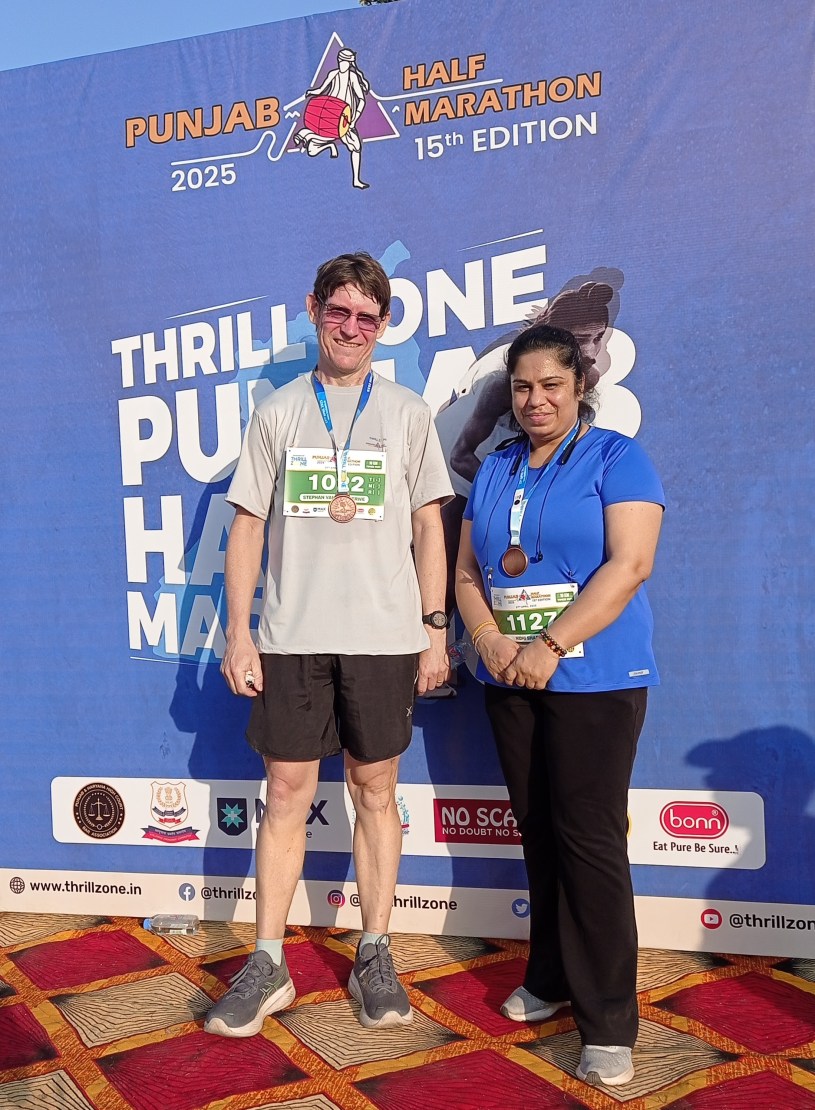
I cross the line in just under 43 minutes. Two dhol players at the finish line are entertaining people and some runners who have finished bhangra energetically. I learned later that my time was good enough to be 9th overall (out of 261 runners) and 1st of 18 in my age category. All glory to My Friend.
I pick up my medal; it is big and heavy. I get some water, get into some impromptu photo sessions and conversations. I love the goodwill and encouraging atmosphere that is always present between runners. I do my stretching routine, pick up my phone from the car, and synced my run to check my stats.
After the race:
I then waited for a colleague whom I am coaching for the marathon. I slowly jogged back on the route until I found her. She ran 10k around 10 years ago when we had a good group of runners and some training going on. Now she finally managed to do that again. Next will be a half-marathon for her – probably after 6 months.
We decide to give the customary breakfast after the race a skip this time. We both have places to be.
I am thankful to God that I still have the strength to run and that it still gives me so much enjoyment. Every runner has their own rhythm and routine on race day, and while some things here in India may feel strange to some, the mix of anticipation, focus, and camaraderie is likely a familiar feeling. I’d love to hear about your own unique race day rituals – what are the non-negotiables that get you to the starting line and across the finish? Share your experiences in the comments below!
Keep running
Stephan
 Running with a Friend