
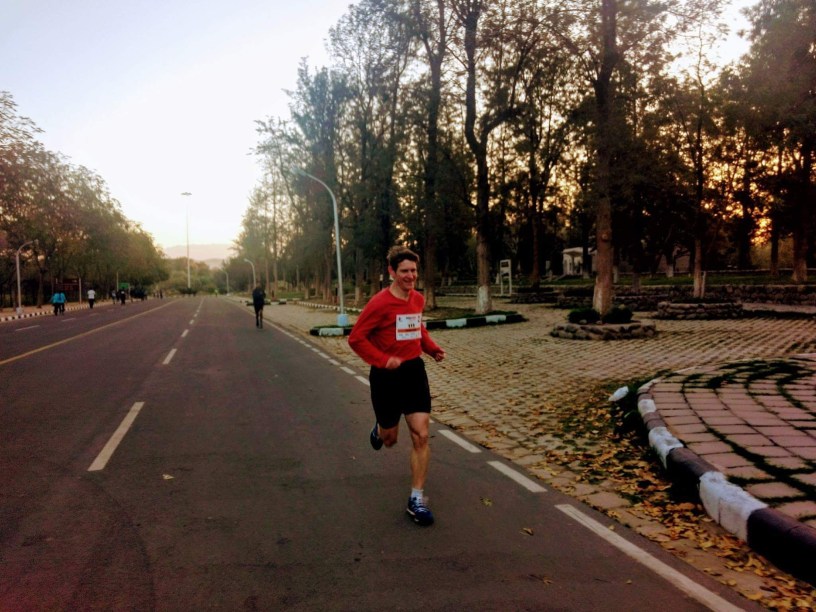
Have you ever wanted to restart something you used to do or increase how much you’re currently doing? Sometimes it can feel like flipping a switch or changing gears, but that doesn’t work for running or for any type of exercise. If you want to start running and aim to complete 5km, or if you’ve been competing in 5km runs and want to run a half marathon, you need a plan to scale up slowly.
Your plan needs to be comprehensive, taking into account your current fitness level and your goals. It should also be flexible enough to handle unexpected life events. The plan will serve as a guide to help you remember what you are doing and a motivator to keep you accountable. If you share your plan with someone else, it will further help you to stick to it.
Here’s an example of a plan I created for someone I’m coaching for a marathon. Although she ran a half-marathon once, more than 10 years ago, she did not continue but harbored a dream to one day run a marathon. When I heard about it, I agreed to be her coach. She followed a plan to get her to 5km, which she ran in September last year. Life got in the way, but she still managed to scale up to 10km. And now it is time to scale up further.
The starting point
She ran a 10k on April 27 in 1 hour and 26 minutes. She did approximately 20km a week in the run-up to it. However, from then until now (May 24) she did not run. I assume her fitness level dropped to 10k a week, which will be our starting point. Speed is not very important to her, but to run a half marathon under the cut-off time of about 3 hours, she would have to work on that as well. Her average pace of 8:36 would have to come down to 8:32 and that over a longer distance. Still, I think it is doable.
The target
She wants to run a half marathon (21.1 km) on November 16, 2025, which is 25 weeks away. She has to complete that, as I said, in 3 hours. She would have to scale up her distance and speed to the point where she can comfortably run this distance within the required time.
Some ground rules
One cannot scale up either distance or speed too fast, as you will get injured. The rate at which one can scale up distance depends on many factors, including previous fitness, age, natural talent, and weight, but here are the rules I follow:
- Don’t scale up more than 10% week over week. This is just a rule of thumb, but the reality is that it is much easier to scale from 10 to 11 than from, say, 74 to 81.
- Often, following a hard week with an easier week helps prevent burnout and the type of fatigue that interferes with life.
- One long run a week should be between 20% and 40% of the weekly distance.
- For a half marathon, aim for the longest long run to be 17 or 18km.
- Peak your training 2-3 weeks before the race for a half marathon.
- Peak with about double the race distance in a week (42km for a half marathon, but if you can get that to 50 km, that is even better).
- Keep steady around that peak for 2-3 weeks.
- Rest at least one day a week.
- Tapering (doing less) between the peak and the race is as important as the build-up.
- Stretching religiously every day for at least 10 minutes is essential to prevent injuries.
- The majority of running should happen at an easy pace.
Making the plan
Distance
So, let’s say 3 weeks before the race, she will peak at 42 km. That means she has 22 weeks to get from 10km a week to 42km a week. Applying the 10% rule would get her to 81 km, so we could modify this and allow for a safer, slower scale-up. Here is what I came up with for her:
| Week | Distance (km) | Week | Distance (km) |
| 1 | 10 | 12 | 24 |
| 2 | 12 | 13 | 28 |
| 3 | 14 | 14 | 30 |
| 4 | 14 | 15 | 32 |
| 5 | 16 | 16 | 30 |
| 6 | 18 | 17 | 34 |
| 7 | 20 | 18 | 36 |
| 8 | 18 | 19 | 38 |
| 9 | 22 | 20 | 36 |
| 10 | 24 | 21 | 40 |
| 11 | 26 | 22 | 42 |
It is more than 10% in the beginning, but I reckoned that she already ran 20km a week not too long ago. By the time it reaches 20km a week, it is down to 10% or less. I also started building in easier weeks later in the program. One can also achieve easier weeks by making the speed training less challenging.
How she divides the running through the week depends on what is happening in her life. Usually, a weekend would provide an opportunity to do a longer run, and a long run is important to get the needed stamina.
Speed
The majority of running should happen at an easy pace. I am not going to go into heart rate and all that for now. In her case, it is mostly about the distance and less about the speed. However, speed work also improves endurance. After reaching around 30 km a week, I will prescribe for her one day a week one of these speed exercises:
- Intervals: This can be short sprints of 100 to 400 meters at roughly 80-90% effort, followed by slow jogging for equal distances.
- Time trial: Run a 5 km as fast as you can.
- Fartlek: These alternate fast and easy running, but the distance/time can vary. I usually prefer between 30 and 60 counts of hard running followed by similar periods of slow running. Then repeat.
- Hill repeats: Sprint up the hill, jog down. Repeat. These can be grueling.
And there you have an outline for a plan to go from 10km to the half marathon.
A plan helps to keep you on track, but there are other aspects that we don’t have time to talk about now. These include getting the right longer distance shoe for your type of foot and running style, what you should eat and drink in general, during practice, and during the race, which stretches are essential for runners, and a number of other things. I may take up one of these topics for next week’s blog.
The mind game
Being consistent, but flexible is key. If you miss some runs or miss your total for the week, make the needed adjustment. I always remember that rest is also important. Today’s rest may help me to run faster or further tomorrow. If you can find a running partner, or a running group, that helps for accountability because now there is another person that will wait for you if you are not there. And tell someone close to you your running goals.
Reward yourself, keep track of your streak, post on social media, go to beautiful places to run, write words with your Strava path, dedicate your running to Jesus, do whatever it takes to help you be consistent. (I have done all of these things over the years! I am sure you can think of something that will help you.)
Let me know what you think of this. Was it helpful? Do you have any questions about scaling up?
Keep running
Stephan
 Running with a Friend
This was interesting. I’m training for a half in September only I’m starting from Scratch- c25k then hal higdon’s novice 2 half marathon plan. Interesting to see how you spread it out. Does she have a full marathon booked yet?
LikeLike
She has not. We should have a full marathon here in April. If she pulls of the half marathon, scaling up to the marathon is possible in 3 months I believe.
LikeLiked by 1 person
Also, all the best for your scaling up and half marathon. Keep writing your blog that I can follow along.
LikeLike